
Tracking Brooding Turkey Mom & Nest
By Lisa Hayden, Ex. Dir.
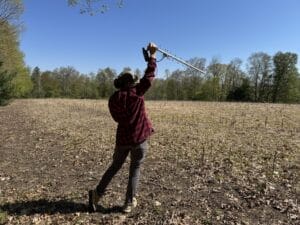
Is that a snapping turtle?” asked Chelsea, as the three of us cautiously approached a field on the Wyndham Land Trust’s Nightingale preserve, where a gray-black blob resembling part of a car tire was curled amid corn stubble.
Before we took a step or two, the mound emerged as a large bird and transformed into the shape of a turkey, which rose up from the ground and took flight toward a line of trees in a blur of powerful wings. A good sign, but we weren’t sure this was the turkey we were looking for (was that turkey wearing a backpack?).
Chelsea Maione, a contract biologist with the Wildlife Division at the Connecticut Department of Energy & Environmental Protection (CT DEEP) and University of Rhode Island Master’s student, held up her antenna and listened for a break in the static indicating that a wild turkey hen wearing a GPS transmitter could be nearby. Liam Mitchell, a CT DEEP seasonal employee, carried a wildlife camera, and their goal was to set it up close enough to observe the nesting success of the tagged hen.
Chelsea stepped closer and saw no nest where the turkey we came upon had flown from. We didn’t seem to be near enough to where the GPS coordinate indicated our target turkey hen was nesting. So, Liam and I followed Chelsea’s lead through the pastures, stepping as quietly as possible, so as not to spook the hen. Hens will at times take a break from the nest, but if they get suddenly bumped off, they sometimes don’t return. We stopped at a downed tree as Chelsea gingerly approached the suspected nest area, likely beneath a cluster of barberry bushes. This is a good spot to shelter a nest full of eggs from fox, bobcat or coyote predators, she said.
The reason for the research, part of her thesis, is to study the nesting success of wild turkeys in Eastern Connecticut. The goals of the study are to determine cause-specific mortality and nest fate, quantify vegetative structure of nest sites and compare nest site selection, and quantify fledge rate of successful nests. Findings can help guide wildlife and habitat management policy, such as amending bag limits for turkeys or their predators or creating more habitat. (Currently hunters can take up to 5 bearded birds in the spring and the fall hunting season.)
Many eggs do not survive to hatch into poults, and many juveniles don’t make it to adulthood (studies indicate only about 25% of hatched poults live beyond 4 weeks). Between 2025-2026 Chelsea and her team have deployed 72 GPS transmitters on wild turkey hens. So far, in 2026 they have discovered 36 nests of which 19 have failed.
With the camera in place near the suspected nest, Chelsea & Liam departed to visit the site of the first successful nest of the season in Canterbury, to count the number of hatched eggshell fragments to determine hatch rate.
So far, the turkey mom hasn’t appeared for a close-up on the game camera at the WLT property, which CT DEEP can monitor remotely via cellular connection, though another hen turkey, deer and a coyote were spotted. This is not unusual, said Chelsea, and data suggests Mom is still incubating. Wild turkey incubate their eggs for 28 days and this hen’s eggs would be expected to hatch by the end of May. WLT’s mission includes promoting scientific understanding in order to best care for the land, and we’ll stay posted on the outcome of the research.